
Master Sudoku With Smart Strategies for Endless Puzzle Fun
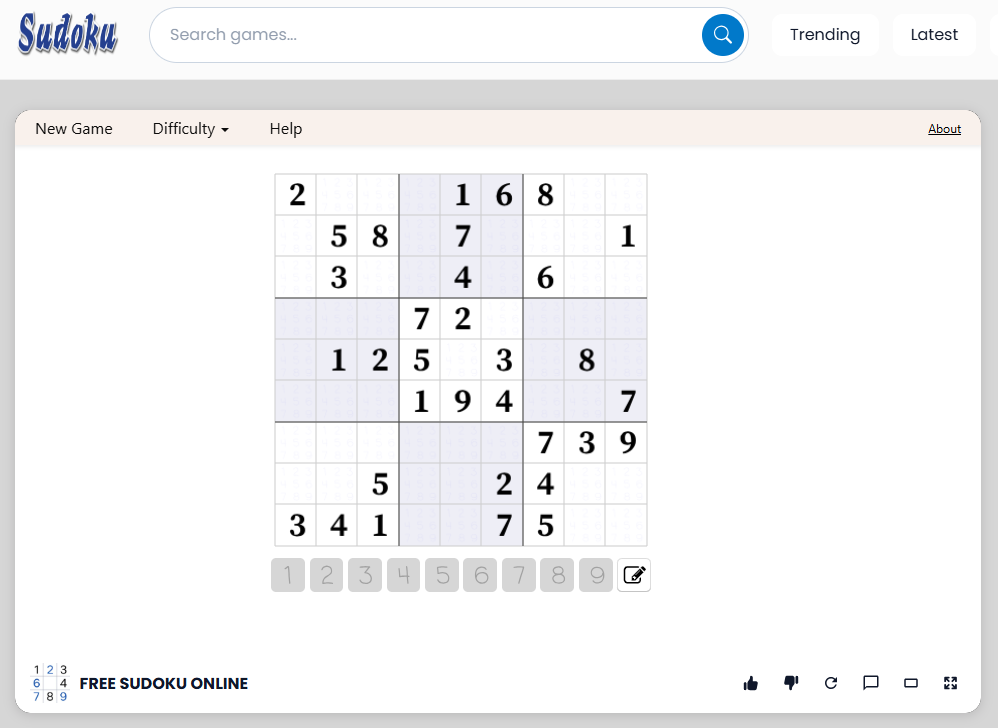
Sudoku is a popular logic puzzle that offers a simple concept with endless opportunities for challenging gameplay. The puzzle uses numbers, patterns, and logical thinking to create an engaging experience for players of many ages. Although the basic rules are easy to understand, advanced puzzles can require patience, careful observation, and strong problem-solving skills.
Playing Sudoku can provide more than entertainment. Regular puzzle sessions can encourage concentration, logical reasoning, memory skills, and attention to detail. Whether you are a beginner searching for an enjoyable introduction to number puzzles or an experienced player looking for a difficult challenge, Sudoku can provide a satisfying mental workout.
What Is Sudoku?
Sudoku is a number-based logic puzzle that normally uses a 9 by 9 grid. The large grid contains 81 cells divided into nine smaller 3 by 3 regions. The main objective is to fill every empty cell with a number from 1 through 9.
Each row must contain every number from 1 through 9 without repetition. The same rule applies to every column and every 3 by 3 region. Some numbers are provided at the beginning of a puzzle, while the remaining cells must be completed through logical deduction.
Understanding the Basic Grid
The Sudoku grid may look complicated at first, but the structure is quite organized. Every cell belongs to one row, one column, and one 3 by 3 region. This relationship creates the foundation for solving the puzzle.
A number placed in one cell affects the possible choices in the corresponding row, column, and region. Careful observation can therefore reveal useful information without requiring random guesses.
Why Sudoku Is Easy to Learn
Sudoku does not require advanced mathematics. Players only need to understand the rules and use logical reasoning. Simple elimination techniques can help beginners identify possible numbers for empty cells.
The absence of complicated calculations makes Sudoku accessible to a wide range of players. With regular practice, solving techniques can become more natural and efficient.
How to Play Sudoku Effectively
Successful Sudoku solving depends on recognizing patterns and eliminating impossible choices. Instead of placing numbers randomly, players can examine relationships between empty cells and existing numbers.
A useful starting point is to search for rows, columns, or regions that already contain many numbers. These areas usually have fewer missing values, making potential solutions easier to identify.
Use Number Elimination
Number elimination is one of the most useful techniques for beginners. When examining an empty cell, check the numbers already present in the same row, column, and 3 by 3 region.
Any number that already appears in one of these areas cannot be placed in the empty cell. Continue eliminating impossible numbers until only one valid option remains.
This method creates a logical path through the puzzle and reduces the need for guessing.
Look for Hidden Opportunities
Sometimes a particular number can appear in only one empty cell within a row, column, or region. Even when several cells remain empty, the position of a specific number may be limited.
Identifying these opportunities can help unlock difficult sections of a Sudoku puzzle. Players should regularly scan the entire grid instead of focusing on only one area.
Advanced Sudoku Strategies
As puzzles become more difficult, basic elimination may not always be enough. Advanced strategies can help players solve puzzles that contain fewer obvious placements.
These techniques require stronger pattern recognition and more careful analysis. Learning them can make difficult Sudoku challenges more enjoyable and less frustrating.
Use Candidate Numbers
Candidate numbers represent possible values for an empty cell. Players can mentally track candidates or write small notes while solving a puzzle.
When another number is confirmed elsewhere in the same row, column, or region, that number can be removed from related candidate sets. Gradually, the remaining possibilities become narrower.
Candidate management is especially useful when several cells appear to have multiple possible answers.
Recognize Pair Patterns
A pair occurs when two cells within the same row, column, or region share the same two possible candidates. If those two numbers can only occupy those two cells, other cells in the same area cannot use either number.
Recognizing pair patterns can remove unnecessary possibilities and reveal new placements. This technique becomes increasingly valuable in challenging puzzles.
Examine Intersections Carefully
Rows, columns, and 3 by 3 regions interact with one another. A number that can only appear in a specific part of a region may provide information about a related row or column.
Examining these intersections helps players discover hidden restrictions. This approach encourages systematic thinking and can reveal solutions that are difficult to notice through simple scanning.
Benefits of Playing Sudoku
Sudoku provides an entertaining way to exercise mental skills. The requirement to evaluate possibilities and make logical decisions encourages active concentration throughout a puzzle.
Many players also enjoy Sudoku because every completed section provides a clear sense of progress. Even a difficult puzzle can become manageable when solved one logical step at a time.
Improve Concentration
Sudoku requires sustained attention. Players need to remember existing numbers, compare different areas, and evaluate possible placements. This process encourages focused thinking and reduces distractions during gameplay.
Regular practice can make it easier to remain attentive while working through increasingly complex puzzles.
Develop Logical Thinking
Every successful placement in Sudoku should follow a logical reason. Players learn to compare evidence, eliminate incorrect possibilities, and identify the most likely valid position.
This type of reasoning makes Sudoku an enjoyable mental exercise for people who appreciate structured challenges.
Enjoy Relaxing Puzzle Sessions
Sudoku can also provide a relaxing activity. The repetitive process of scanning the grid and finding logical connections can create a focused experience.
Players can enjoy a short puzzle during a break or spend more time solving a challenging grid. The flexible format makes Sudoku suitable for different schedules and preferences.
Tips for Becoming Better at Sudoku
Improvement comes from consistent practice and careful analysis. Beginners should focus on accuracy rather than speed. Trying to complete a puzzle quickly can lead to unnecessary mistakes.
Start with easier grids and gradually move toward more difficult challenges. Reviewing mistakes can also reveal patterns that need more attention.
Avoid Random Guessing
Random guessing can create confusion because one incorrect number may affect several connected areas. Logical deduction is usually a safer approach.
When no obvious placement appears, review candidate numbers and search for hidden patterns. Taking a short pause can also help reveal information that was overlooked earlier.
Build a Consistent Solving Routine
A consistent routine can make Sudoku solving more efficient. Scan rows, columns, and regions systematically rather than moving randomly around the grid.
With practice, players can develop a personal solving method. Familiarity with common patterns can also reduce the time required to identify useful placements.
Why Sudoku Remains Popular
Sudoku continues to attract players because the core rules remain simple while the potential difficulty is almost unlimited. A basic grid can introduce the puzzle to new players, while advanced configurations can challenge experienced solvers.
The puzzle also works well in both physical and digital formats. Players can enjoy Sudoku in newspapers, puzzle books, websites, and mobile applications. Easy access makes it possible to practice almost anywhere.
A Puzzle for Different Skill Levels
Sudoku can accommodate beginners, intermediate players, and experts. A beginner can learn basic elimination techniques, while an experienced solver can explore advanced strategies and increasingly difficult grids.
This gradual learning curve gives Sudoku lasting appeal. Players can continue developing skills without needing to change to a completely different type of puzzle.
Conclusion
Sudoku combines simple rules with deep logical challenges, creating an engaging puzzle experience for many types of players. Understanding the grid, practicing number elimination, recognizing candidate patterns, and using advanced strategies can make solving more enjoyable and effective.
Whether the goal is relaxation, mental exercise, or personal improvement, Sudoku offers an accessible way to spend time with a meaningful challenge. With regular practice and a systematic approach, players can become more confident and discover new levels of puzzle-solving ability.

 Arabic
 French
 Spanish
 Portuguese
 Deutsch
 Turkish
 Dutch
 Italiano
 Russian
 Romaian
 Portuguese (Brazil)
 Greek